

Buying a 12-setting dinnerware collection gives you enough place settings for family meals, guests, and larger gatherings, but the number of pieces also affects how much space you need at home. A full set must fit comfortably in your cabinets, leave enough room on the dining table, and work with your dishwasher without requiring awkward loading. These dimensions can be planned before purchase to avoid overcrowding, wobbles, and tables that are too cramped.
If you're looking at a service for 12 dinnerware sets, or if you're adding to your collection over time, you should be thinking about the shapes and sizes of the dinnerware, not just the number of sets.

What Counts as a 12-Setting Dinnerware Set?
A 12-setting collection does not imply that there are 12 or 24 individual pieces. Some collections contain an additional serving piece, and each place setting can contain a dinner plate, salad or dessert plate, bowl, and mug. So, if you're serving a 12-person meal, you could be serving dozens of individual items on each plate, bowl, cup and accessory. The pieces vary from manufacturer to manufacturer, so be sure to check the full count of pieces before estimating storage needs.
Measure One Complete Place Setting First
Before planning cabinet space, measure one complete place setting. The first plate to consider is the largest, typically the dinner plate, as this will determine if your shelves and cupboards are deep enough. Next, stack the same plates and record the total height. Bowls and mugs should be measured individually as the shape of the bowl and mug can create unused vertical space.
For example, if twelve dinner plates are stacked together, measure the actual stack rather than multiplying an assumed thickness. Do the same with smaller plates and bowls. A deep bowl will need more vertical clearance than a flat plate, and mugs will need more space due to their handles. This is a much more accurate way to measure storage space than the package size, since it's just a single measurement.
Determine Cabinet Space for Plates, Bowls and Mugs
To determine the number of cabinets, measure the width, depth and height of the shelf, not including obstructions such as hinges, doors, shelf supports, etc. Compare these measurements with your dinnerware stacks. Plates are typically stored horizontally, but not so high that they must be lifted to remove one.
Provide sufficient clearance above each stack for easy removal. Bowls can be nested, but may not fit tightly if the bowl is unusual in shape or texture. Mugs are typically the least efficient item since they have handles which make close packing difficult. If your cabinets are shallow, you may want to keep mugs in a separate section or use an open shelf or a mug rack.
In the case of dinnerware sets and dishware, keep in mind that the efficiency of storage is as much about the shape as it is about the number. A set of 12 large plates can take up more space in the cabinet than a set of smaller plates that are stackable. You can explore different dinnerware formats and configurations here: MALACASA dinnerware sets.

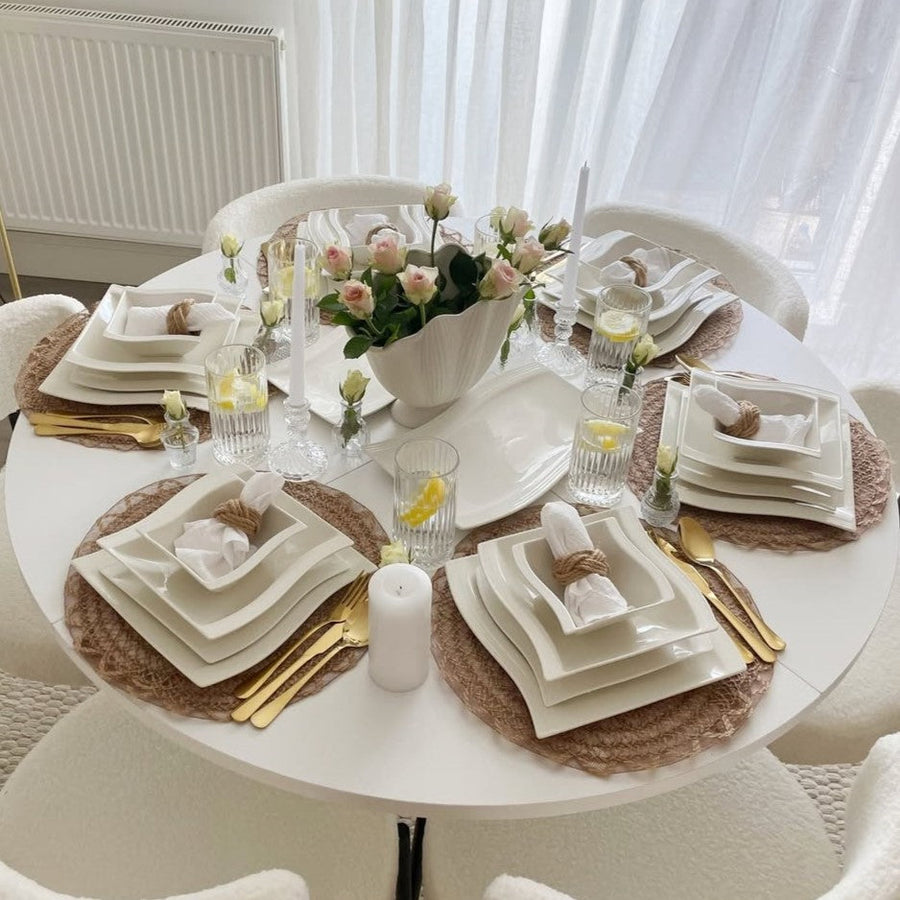
Will Twelve Settings Fit on Your Dining Table?
There must be more than 12 plate positions on a table. There should be sufficient personal space for each person to place their plate, utensils, glass, and have room to maneuver their arms. For general planning purposes, provide about 20 inches of table edge space for each person for comfortable eating. If the tables are shaped like a rectangle and all the diners are seated along the long sides and ends, then about 20 feet of table-edge space is needed for 12 people.
In addition, you should consider bowls, platters, water glasses, condiments and communal dishes. A large plate can hold 12 people, but it doesn't have a lot of room for food in the middle. For frequent hosting, a wider table or a sideboard for serving dishes can make a much bigger difference than simply choosing smaller plates.
Plan Dishwasher Loads for a Full Dinner
A full 12-setting meal can make for a large dishwasher load. When purchasing, look at the dishwasher's rack design and the largest plate size it will fit. The plates should be held firmly between the rack tines and not be placed too close together, and the bowls are typically angled so that water can reach the inside of the bowl.
Mugs can be in the upper rack, but large handles and wide shapes can take up space. If oversized bowls or plates are used, it may be impossible to place all twelve settings in one cycle. After a big meal, two dishwasher loads might be more attainable for many homes, particularly if pieces, cookware and glasses are being washed as well.

One Large Set or Two Coordinating Sets of Six?
A 12-setting set provides uniformity and simplifies setting up the table with matching pieces. It can also be handy if you have a lot of bigger groups. For smaller households, however, two sets of six can offer more flexibility in coordinating. One can be used regularly and the other used when visitors come.
Two sets can also make it easier to make replacements if one set becomes unavailable. Some sets may allow for replacement of damaged parts without affecting other sets. The main consideration is whether the two sets stack efficiently and whether their styles coordinate when used together.
How Many Spare Pieces Should You Keep?
You do not necessarily need a thirteenth complete place setting. Rather, have a couple of extra parts that are most likely to fail or be used extensively. Mugs and dinner plates might be worthy of a higher priority as they are used often. If you have a family that eats soup, cereal, or dessert often, then extra bowls can come in handy, too.
Replacement availability is also a factor. When individual pieces are sold separately, damaged pieces can be replaced as necessary. If the collection is difficult to replenish, buying a few extras at the beginning may be more practical, particularly if you host often.

A Pre-Purchase Measuring Checklist
When buying 12 setting dinnerware sets, determine the width, depth and vertical clearance of your cabinet. Check whether the dinner plates can stack safely and whether bowls can nest without becoming difficult to remove. Determine the size of your dining table and factor in the amount of space needed for 12 guests and food service. Look at the size of the dishwasher rack and the largest plate size, and consider if mugs will fit.
Last but not least, think about where the original packaging will end up if you only use the complete collection from time to time. Large boxes can be helpful for long-term storage, but can take up a lot of closet space. Also consider lifting: very tall stacks of heavy stoneware or porcelain can be difficult to handle safely. A smaller service for 12 dinnerware sets might be more convenient to store and use than a larger service that fits but is difficult to reach.
12-Setting Dinnerware Space FAQs
Q1: How Many Pieces Are Usually in a 12-Setting Dinnerware Set?
The total varies. Dinner plates, smaller plates, bowls, and mugs can all be included in 12 place settings, and some collections even include serving pieces. Always check the manufacturer's complete item count.
Q2: Do Mugs Take a Lot of Storage Space?
They can. Twelve mugs may take up more cabinet width than you think, because of handles. Check the height, width and clearance of the handle of the mug before buying.
Q3: Is It Possible for a Smaller Family to Eat From a 12-Place Setting Dinnerware Set Every Day?
Yes. If you have sufficient space in your cabinets and dishwasher, a 12 setting collection can be effective for a smaller family. The benefit is that you'll have matching pieces on hand when guests arrive.
Q4: Is a 12-Setting Dinnerware Collection Too Large for a Small Kitchen?
Not necessarily. The important factor is the actual dimensions and stackability of the pieces. Compact designs may be much easier to store than bulky shapes with large footprints.
Q5: Should I Purchase a Full Set or Develop a 12 Setting Collection Over Time?
If you have ample space, a complete set is the best option, but if you are looking to buy gradually, you can select the items that you need. When space is limited in the cabinet, it is important to measure each piece before adding it to the collection to avoid overcrowding.
Q6: Which Is the Most Crucial Measurement Before Purchasing?
First measure the width and height of your cabinets, then the dishwasher's largest plate size. These are typically the two areas that pose the greatest practical constraints for a complete collection of 12 settings.